Real‑time motors, cables, and a stage: How we built 3D position plotting software
Fun Friday: A simple motion system that uses three motors and cables to move a plate anywhere in a room.

By Find Digital | Published on December 23, 2025

This project started with a very simple idea.
We needed a plate that could move anywhere inside a room, the plate had to be able to carry things like a wireless camera or a small prop attached with magnets.
It needed to move smoothly and safely, without blocking the floor or hitting people on their heads
To do this, we decided to hang the plate using cables. We used three motors mounted high up in the room. Each motor had a cable connected to the plate.
By making each cable longer or shorter, the plate could move in any direction.
We were aware that there was still things to resolve, between motor rotation per second, spools, and the rope we’d use, but conceptually, that didn’t matter.
The first thing we built was a basic compute program. This understood where things were in the room using simple 3D positions. From that, we could calculate how long each cable needed to be to place the plate at a specific point. This meant constantly doing maths to keep the cables tight and balanced.
If we dropped a cable’s tension, we could loose the plate into someone’s head… Not good.
Once we proved the idea worked with some manual maths, we improved how it moved. Instead of telling the plate to jump straight to a new position in one solid move, we made it move in small steps. This made the motion smoother and gave us much more control on the path it would take.
After that, we added path generation. At first, the plate just moved in a straight line from one point to another. That works in an empty room, but real rooms are not empty. There are speakers, truss, walls, projectors and other equipment either on the floor or the ceiling.
So we added obstacle avoidance. The system now checked the space ahead and planned a safe route. If a straight line is not possible, it can move in curves or gentle shapes to go around objects. It checks the cables during path generation to make sure that we didn’t end up in a bind around a projector or something.
Once the movement was solid, we wanted the system to talk to other equipment. We added UDP output so lighting consoles like MagicQ could receive live plate position data. This means lights could follow the plate as it moves, or later if we decided we could use Chamsys MagicQ consoles to control the positioning.
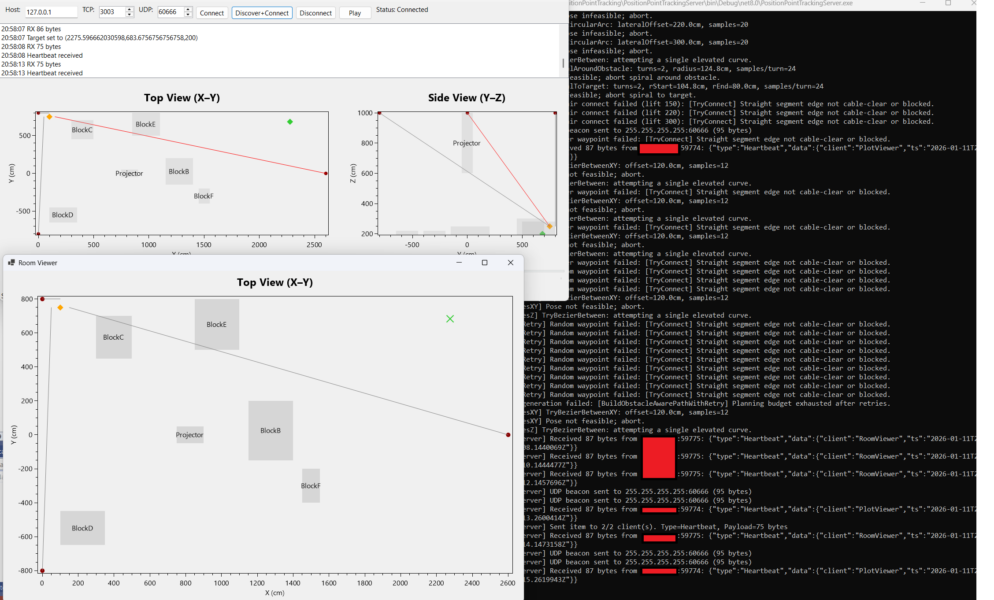
We also built our own TCP interface so we could link the system to a viewer. The viewer is a simple 3D display of the room. You can see the motors, the cables, the plate, and the path it plans to take.
On top of that, we added a position selector. You can click on a point in the room and the system will plan a safe path and move the plate there. You can see the plan before it moves, showing where the plate will teleport.
We haven’t completed this project, in the future we could work on checks for physical devices such as motors, position encoding, wireless control, and speed calculations.
But for now, it works well conceptually and somehow, the math checks out :O
Share this article
Related articles
Looking for more? Explore more articles